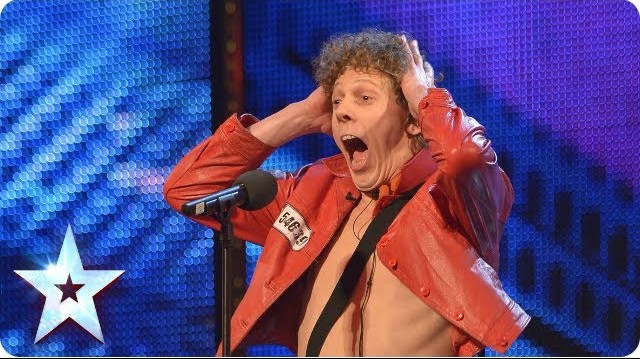
His ability to mix music with personality made his audition unforgettable

LONDON — Every season of Britain’s Got Talent promises a mix of world-class skill, heartwarming stories, and eccentric variety acts. Yet, few auditions live on in reality television history quite like that of Maarty Broekman. In a memorable Week 6 audition from the 2013 series, the 23-year-old Dutch musician set out to conquer the British public and revive a long-forgotten instrument. Armed with boundless optimism, an eye-catching wardrobe, and a strap-on synthesizer, Broekman delivered an unconventional performance that left the judging panel completely and utterly divided.
A Bold Entrance and a Secret Crush
Before a single note was even played, Broekman’s sheer presence shifted the energy in the auditorium. Striding onto the stage in a vibrant, open red jacket, a bare torso, and uniquely patterned, glittering trousers, he immediately exuded the aesthetic of an over-the-top 1980s pop icon.
When asked by the judges about his personal life, Broekman cheerfully admitted he was single. He quickly pivoted the conversation toward judge Alesha Dixon, openly declaring, “I think she’s really pretty” [00:25]. The playful flirting set a lighthearted, comedic tone for the audition, earning giggles from the audience and a flattered smile from Dixon.
Originally from the Netherlands but living in London at the time, Broekman explained his grand mission to the cameras. “This music is the best music ever in the world,” he asserted backstage. “I would love to bring the keytar back. It’s one of the best and sexiest instruments ever” [01:18].
The keytar—a synthesizer keyboard supported by a strap around the neck and shoulders—reached peak popularity during the synth-pop wave of the 1980s. For Broekman, the instrument wasn’t just a retro gimmick; it was the vehicle for his artistic self-expression. He announced he would be performing an original piece titled “Back of Your Lover,” a song he described as being inspired by the thrill and secrecy of a forbidden relationship.
The Performance: Pure Euro-Pop Energy
As the backing track kicked in, Broekman launched into a high-energy routine filled with dramatic poses, wide-eyed enthusiasm, and distinctive vocals. The performance was heavy on electronic beats and unmistakably modeled after the campy, theatrical style often seen at the Eurovision Song Contest.
Broekman danced across the stage, alternating between singing into the microphone and striking poses with his keytar. His enthusiasm was entirely infectious for the crowd, who began clapping along to the steady electronic rhythm. While his vocal pitch and simplistic lyrics raised eyebrows among the more traditional musical critics in the room, his stage presence was undeniable. He gave the performance everything he had, seemingly impervious to the pressure of the massive stage and the watchful eyes of television’s toughest judges.
Simon Cowell Unloads: “The Worst Song I Have Heard”
As the song came to an end, the atmosphere in the room fractured into two distinct camps. Amanda Holden kicked off the critique by praising Broekman’s unyielding positivity. “Your enthusiasm is just so nice to see,” Holden observed. “I’ve never seen anyone so happy to audition” [04:30].
However, the warm atmosphere was instantly cooled when Simon Cowell took the microphone. Known globally for his blunt and often brutal honesty, Cowell did not hold back in his assessment.
“Maarty, I can honestly tell you by a clear mile… that is the worst song I have heard,” Cowell declared [04:41]. “Seriously. Terribly, ridiculous instrument, the horrible lyrics, the terrible singing, the awful costume… whole range is [horrendous].”
Cowell’s scathing critique was met with a chorus of boos from the studio audience, who had clearly taken a liking to the quirky Dutch performer. Despite the harsh words, Broekman kept his trademark smile fixed on his face, absorbing the criticism with remarkable grace.
The Judges’ Verdict: A Shocking Split
What looked like a definitive exit quickly took a surprising turn when David Walliams chimed in. Championing the eccentricities of British variety, Walliams vehemently disagreed with Cowell. “It’s a very romantic song,” Walliams argued, noting that the audience was thoroughly entertained. “I want a pair of those trousers and I want to see more of you, so I’m gonna kick this off with a massive yes” [05:16].
The deciding votes rested with the women on the panel. Amanda Holden aligned with Walliams, praising the pure entertainment value of the act and offering a second “yes.”
With Cowell handing down a firm and predictable “no,” the final decision fell directly onto the shoulders of Alesha Dixon—the very judge Broekman had tried to woo minutes earlier. Weighing the musical shortcomings against the sheer joy the act brought to the room, Dixon laughed and ultimately sided with the public sentiment, delivering the third and final “yes” needed to send Broekman through to the next round.
A stunned Cowell could only look on in disbelief as Broekman celebrated his victory on stage. “What have you done?” Cowell muttered to his fellow judges as the audience cheered [06:57].
The Legacy of a BGT Cult Classic
While Maarty Broekman may not have possessed the classical vocal talent of a traditional pop star, his audition perfectly encapsulated what makes Britain’s Got Talent a cultural phenomenon. It highlighted the eternal conflict between Simon Cowell’s strict commercial standards and the public’s love for unapologetic, joyful, and bizarre entertainment.
Broekman’s audition remains a cult classic for fans of the show, remembered not for pitch-perfect vocals, but for a bright red jacket, a glittering pair of trousers, and a passionate dream to bring the keytar back to the center stage.