The U.S. Food and Drug Administration (FDA) said Midwest Poultry Services recalled nearly 1.6 million dozen eggs — more than 19 million individual eggs — because of possible Salmonella Enteritidis contamination.
The recall affected several brands and carton sizes, but only products with specific codes and dates. Shoppers needed to check their cartons carefully to determine whether their eggs were included.

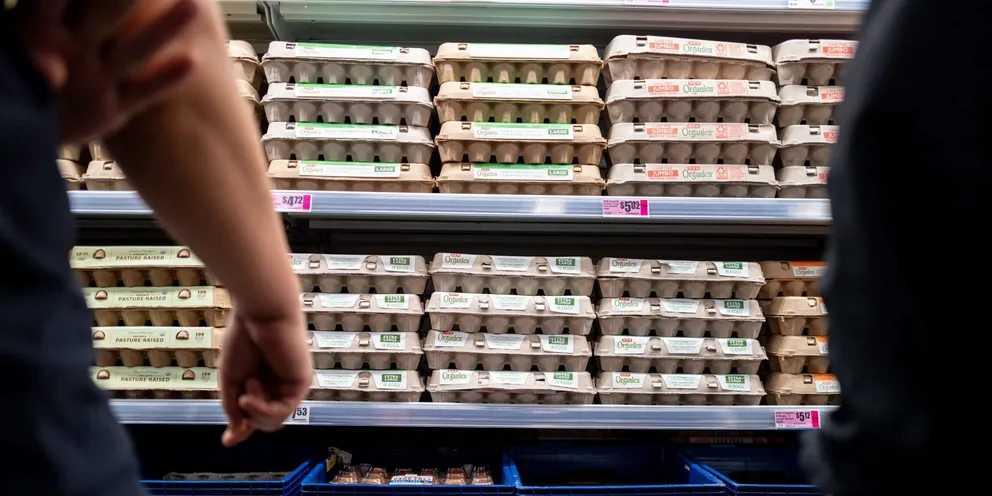
Trays of eggs are displayed for sale. Nearly 1.6 million dozen eggs are included in the Midwest Poultry Services recall. | Source: Getty Images
About 1.6 Million Dozen Eggs Recalled
According to a July 22 FDA notice, Midwest Poultry Services, L.P. recalled white shell eggs and brown cage-free shell eggs from two farms in Texas.
The company distributed the affected eggs from June 6 through July 3, 2026. The products carried sell-by or best-by dates ranging from July 20 through August 17.

A shopper checks cartons of eggs on display as consumers are advised to review product codes and dates. | Source: Getty Images
Midwest Poultry Services said its environmental monitoring and follow-up analysis uncovered the potential issue. In response, the company halted the distribution of fresh eggs from its Texas farms. It reported no known illnesses specifically tied to its products when it announced the recall.
The recall applies only to certain cartons. According to the FDA, affected products bear plant code P-1950 or 0840962, depending on the product, and a Julian date between 157 and 184. Shoppers can find these details printed in date-coding ink on either side of the carton.

Cartons of eggs sit on display. The FDA recall covers specific brands, product codes and date ranges. | Source: Getty Images
Affected products include Kroger eggs in several sizes, certain Simple Truth cage-free brown eggs, and products sold under the Brookshire’s, Country Morning and Sunups brands. Some bulk egg products are also included.
Where the Recalled Eggs Reached Consumers
The recalled eggs reached retailers in several states. According to the FDA, Kroger stores in Texas and Louisiana carried the affected products.
Brookshire Grocery stores in Texas, Oklahoma, Arkansas, Louisiana, New Mexico, and Mississippi also received the eggs, along with smaller retail outlets.

A Kroger store is seen in Houston, Texas. The FDA said affected eggs were available at Kroger stores in Texas and Louisiana. | Source: Getty Images
Since the recall covered only specific codes and date ranges, shoppers needed to review all identifying details on the carton instead of relying on the brand name alone.
The FDA told consumers not to eat any recalled eggs and to return them to the store where they were purchased for a full refund.
The Health Risks From Salmonella
The recall stemmed from concerns that the eggs could contain Salmonella Enteritidis, a bacterium that can cause intestinal illness.
According to the Mayo Clinic, people most often contract Salmonella through contaminated food or water. Raw or undercooked eggs and egg products can also be a source of infection.
Symptoms can include diarrhea, abdominal cramps, fever, nausea, vomiting, chills, headache, and blood in the stool.
Mayo Clinic says symptoms can appear between 6 hours and 6 days after exposure. Most healthy people recover within a few days to a week without specific treatment.
In some cases, diarrhea can lead to severe dehydration and require medical attention. Mayo Clinic also notes that life-threatening complications can develop if the infection spreads beyond the intestines.
The FDA says young children, frail or older adults, and people with weakened immune systems face a higher risk of serious infection.
Mayo Clinic advises contacting a health care provider if an infant, young child, older adult, or person with a weakened immune system has symptoms that last more than a few days, include a high fever or bloody stools, or show signs of dehydration such as reduced urination, dark urine, or a dry mouth and tongue.
Retailers Respond to the Recall
Brookshire Grocery Co. told Reuters that it began reviewing its inventory and removing potentially affected products after receiving notice of the recall.
Brookshire added that all eggs available for purchase in its stores at the time came from a different production facility. Meanwhile, Kroger did not immediately respond to a request for comment made outside regular business hours.
The same outlet also reported that Midwest Poultry redirected eggs to a processing facility for pasteurization and launched internal testing and an investigation into the source of the potential Salmonella Enteritidis contamination.
No other Midwest Poultry Services products are included in the recall. Consumers with questions can contact Midwest Poultry Services at 574-405-9531, Monday through Friday from 8 a.m. to 4:30 p.m. Eastern time.
This isn’t the first time American consumers have faced a large-scale egg recall.
Another Salmonella Egg Recall Hit in 2025
In 2025, at least 1.7 million eggs were recalled across nine states after several people had already suffered harm.
The Centers for Disease Control and Prevention (CDC), the FDA, and public health officials in several states were investigating a multistate outbreak of Salmonella infections linked to eggs.
As health experts continued to investigate the outbreak, more details about the source emerged. On June 6, 2025, August Egg Company issued a recall for organic and cage-free brown eggs.
According to the CDC and FDA, the recalled cartons could be identified by Julian dates ranging from 32 to 126 and plant codes P-6562 or CA-5330 printed on the side of the carton.
The eggs, with packaging made from fiber or plastic, were sold in stores under various brand names such as Clover, First Street, Nulaid, O Organics, Marketside, Raleys, Simple Truth, Sun Harvest, and Sunnyside.
The recalled cage-free and organic brown eggs had sell-by dates between March 4 and June 4, 2025. These were sent to stores in California and Nevada, including Save Mart, FoodMaxx, Lucky, Smart & Final, Safeway, Raleys, Food 4 Less, and Ralphs.
Walmart stores in nine states — California, Washington, Nevada, Arizona, Wyoming, New Mexico, Nebraska, Indiana, and Illinois — also received the eggs, with sell-by dates stretching to June 19, 2025.
Anyone who bought the recalled eggs was advised to throw them away or return them to the store where they were purchased. According to the CDC, 79 people in the affected states had become sick. Officials said the outbreak could have extended beyond those states and that the actual number of illnesses was likely higher than reported.
Later, the size of the recall had been confirmed. August Egg Company was recalling 1.7 million dozen eggs that might carry Salmonella.