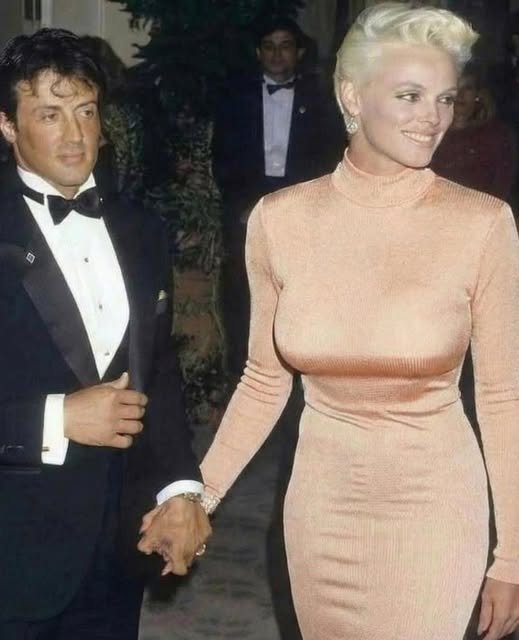
#RambođŸ˜±đŸ˜­Look what you lost, Stallone! This is how the actor’s ex-wife Bridget Nielson looks and lives today

Brigitte Nielsen, once known for her high-profile marriage to Sylvester Stallone, has reemerged in the public eye for far more inspiring reasons. At 60, the actress, model, and television personality is being celebrated for her confidence, grace, and authenticity. Her recent photos on social media have resonated with fans who see her as a symbol of resilience and the beauty of aging with self-assurance rather than fear.

Nielsen first rose to fame in the 1980s with roles in Red Sonja and Rocky IV, quickly becoming an international star. Her marriage to Stallone made her one of Hollywood’s most photographed figures, but the relationship ended after two years, drawing intense media attention. Despite the scrutiny, she continued to build her own career, refusing to let her personal life define her professional identity.

Following her acting success, Nielsen expanded into modeling and television, appearing in various European programs. Her 2018 return to Hollywood in Creed II was both nostalgic and meaningful, as she reprised her role as Ludmilla Drago. She described the experience as a professional and emotional full circle, expressing gratitude for the opportunity to revisit an iconic chapter of her career.

Throughout her journey, Nielsen has been candid about her struggles and personal growth. In a 2014 interview with Oprah Winfrey, she reflected on her battles with fame and self-doubt, emphasizing the strength that comes from acknowledging one’s mistakes. Her honesty inspired many who admired her willingness to reinvent herself.

Her personal life also reflects transformation. Nielsen, a mother of five, welcomed her youngest daughter, Frida, at age 54, describing motherhood later in life as both challenging and deeply fulfilling.

Today, Nielsen’s story represents empowerment through self-acceptance. She reminds audiences that true beauty and vitality come from confidence, courage, and embracing every stage of life.

#RambođŸ˜±đŸ˜­Look what you lost, Stallone! This is how the actor’s ex-wife Bridget Nielson looks and lives today Read More

My husband handed me divorce papers and threatened to ruin me in court if I didn’t sign. So I calmly signed every page, handed him the penthouse keys, and walked away. The next morning, his lawyer called screaming. That’s when he discovered the clause he never bothered to read.

In my own penthouse—the one I paid for long before I met my husband—he handed me divorce papers and told me I had two choices.

Sign.

Or be destroyed in court.

What happened next was the most expensive mistake of his life.

My husband, Derek, always loved winning.

Not succeeding.

Winning.

There’s a difference.

Successful people build things.

Derek preferred taking credit for things other people built.

When we first met, I ignored the warning signs.

The arrogance felt like confidence.

The competitiveness felt like ambition.

God.

I was wrong.

By the time our marriage started falling apart, Derek had convinced himself he was the reason for my success.

Never mind that I owned my company before we met.

Never mind that I bought the penthouse before we married.

Never mind that my investments existed long before he entered the picture.

According to Derek, everything good in my life somehow belonged to him.

Honestly?

The divorce wasn’t surprising.

The way he handled it was.

One afternoon, he arrived home with his attorney.

Not my attorney.

His.

As if the outcome had already been decided.

He dropped a thick stack of documents onto the dining table.

Then smiled.

Not a happy smile.

A smug one.

The kind people wear when they think they’ve already won.

“Either you sign,” he said, “or I’ll ruin you in court.”

The room went silent.

His lawyer shifted uncomfortably.

Even she seemed embarrassed.

But Derek kept talking.

Apparently, he’d convinced himself that a long legal battle would force me to surrender.

That I’d panic.

Beg.

Fight.

Cry.

Anything except what I actually did.

I picked up the documents.

Read every page.

Then I signed them.

Every single one.

Without argument.

Without hesitation.

God.

The look on his face was priceless.

He actually seemed disappointed.

Like he’d prepared for a battle and accidentally arrived at a surrender ceremony.

Then I handed him my set of keys.

Stood up.

Grabbed my purse.

And walked out.

Behind me, I heard him laugh.

Actually laugh.

Honestly?

That was my favorite part.

Because people only laugh like that when they’re absolutely certain they’ve won.

That night, I checked into a luxury hotel downtown.

Ordered room service.

Took a long bath.

And slept better than I had in years.

No anxiety.

No arguments.

No walking on eggshells.

Just peace.

Pure peace.

Meanwhile, I imagined Derek celebrating.

Probably calling friends.

Probably bragging.

Probably admiring his new penthouse.

The penthouse he believed he’d stolen from me.

Then morning arrived.

And reality arrived with it.

At 8:12 a.m., Derek’s phone rang.

It was his lawyer.

According to multiple people who later told me the story, the conversation started badly and got worse.

Fast.

Apparently she was screaming.

Not speaking.

Screaming.

Loud enough that employees outside her office could hear every word.

“You signed it?”

Long pause.

“You actually signed it?”

Another pause.

Then came the sentence that changed everything.

“You just agreed to the worst clause possible.”

God.

For the first time, Derek stopped feeling victorious.

Because there was one small detail he had overlooked.

One tiny detail hidden inside the documents he was so eager to force me to sign.

See, Derek never actually read the final version.

He skimmed it.

Assumed it matched earlier drafts.

And signed.

Confident people often stop paying attention.

Arrogant people stop reading entirely.

The clause in question involved the penthouse.

Technically, he received possession of it.

Exactly what he wanted.

But possession wasn’t ownership.

Not even close.

The property remained protected under a trust established years before our marriage.

A trust he knew existed.

A trust he thought he’d found a way around.

He hadn’t.

The agreement granted him temporary occupancy.

Nothing more.

And occupancy came with conditions.

Very expensive conditions.

Property taxes.

Maintenance.

Association fees.

Insurance.

Assessments.

Everything.

Every dollar.

His responsibility.

The penthouse looked glamorous from the outside.

What Derek never understood was that maintaining it cost nearly as much as an average family’s annual income.

God.

The monthly expenses alone were staggering.

Meanwhile, I retained ownership through the trust.

Completely.

Legally.

Permanently.

The clause was crystal clear.

His lawyer had included it intentionally.

My lawyer had approved it immediately.

Everyone understood it.

Everyone except Derek.

Because Derek never read it.

Apparently, he was too busy celebrating.

The real disaster arrived six months later.

The luxury building announced major structural renovations.

Mandatory renovations.

Every owner and occupant received assessments.

Massive assessments.

The kind that make people dizzy.

Guess who was contractually responsible?

Derek.

By then, backing out wasn’t possible.

The agreement had already been finalized.

Legally binding.

Enforceable.

Ironclad.

Honestly?

I almost felt bad.

Almost.

Then I remembered the threats.

The intimidation.

The arrogance.

The attempts to bully me into submission.

And suddenly I felt much better.

Within a year, Derek voluntarily surrendered occupancy.

The penthouse returned to me exactly as planned.

Meanwhile, he spent thousands trying to escape obligations he willingly accepted.

The irony was beautiful.

Because the man who wanted everything ended up paying dearly for something he never truly owned.

Years later, people still ask why I signed so quickly.

The answer is simple.

Because I read the documents.

That’s it.

No secret strategy.

No manipulation.

No trick.

Just reading.

Carefully.

Patiently.

Completely.

It’s amazing how many disasters can be avoided by doing something most people skip.

Especially when arrogance convinces them details don’t matter.

Derek thought the documents represented his victory.

I knew they represented my freedom.

And sometimes freedom is worth far more than any penthouse.

Especially when the person trying to take it believes they’ve already won.

Because the most dangerous mistake someone can make isn’t underestimating their opponent.

It’s overestimating themselves.

And that mistake cost Derek everything.

My husband handed me divorce papers and threatened to ruin me in court if I didn’t sign. So I calmly signed every page, handed him the penthouse keys, and walked away. The next morning, his lawyer called screaming. That’s when he discovered the clause he never bothered to read. Read More

RambođŸ˜±đŸ˜­Look what you lost, Stallone! This is how the actor’s ex-wife Bridget Nielson looks and lives today

Brigitte Nielsen, once known for her high-profile marriage to Sylvester Stallone, has reemerged in the public eye for far more inspiring reasons. At 60, the actress, model, and television personality is being celebrated for her confidence, grace, and authenticity. Her recent photos on social media have resonated with fans who see her as a symbol of resilience and the beauty of aging with self-assurance rather than fear.

Nielsen first rose to fame in the 1980s with roles in Red Sonja and Rocky IV, quickly becoming an international star. Her marriage to Stallone made her one of Hollywood’s most photographed figures, but the relationship ended after two years, drawing intense media attention. Despite the scrutiny, she continued to build her own career, refusing to let her personal life define her professional identity.

Following her acting success, Nielsen expanded into modeling and television, appearing in various European programs. Her 2018 return to Hollywood in Creed II was both nostalgic and meaningful, as she reprised her role as Ludmilla Drago. She described the experience as a professional and emotional full circle, expressing gratitude for the opportunity to revisit an iconic chapter of her career.

Throughout her journey, Nielsen has been candid about her struggles and personal growth. In a 2014 interview with Oprah Winfrey, she reflected on her battles with fame and self-doubt, emphasizing the strength that comes from acknowledging one’s mistakes. Her honesty inspired many who admired her willingness to reinvent herself.

Her personal life also reflects transformation. Nielsen, a mother of five, welcomed her youngest daughter, Frida, at age 54, describing motherhood later in life as both challenging and deeply fulfilling.

Today, Nielsen’s story represents empowerment through self-acceptance. She reminds audiences that true beauty and vitality come from confidence, courage, and embracing every stage of life.

RambođŸ˜±đŸ˜­Look what you lost, Stallone! This is how the actor’s ex-wife Bridget Nielson looks and lives today Read More

RambođŸ˜±đŸ˜­Look what you lost, Stallone! This is how the actor’s ex-wife Bridget Nielson looks and lives today

Brigitte Nielsen, once known for her high-profile marriage to Sylvester Stallone, has reemerged in the public eye for far more inspiring reasons. At 60, the actress, model, and television personality is being celebrated for her confidence, grace, and authenticity. Her recent photos on social media have resonated with fans who see her as a symbol of resilience and the beauty of aging with self-assurance rather than fear.

Nielsen first rose to fame in the 1980s with roles in Red Sonja and Rocky IV, quickly becoming an international star. Her marriage to Stallone made her one of Hollywood’s most photographed figures, but the relationship ended after two years, drawing intense media attention. Despite the scrutiny, she continued to build her own career, refusing to let her personal life define her professional identity.

Following her acting success, Nielsen expanded into modeling and television, appearing in various European programs. Her 2018 return to Hollywood in Creed II was both nostalgic and meaningful, as she reprised her role as Ludmilla Drago. She described the experience as a professional and emotional full circle, expressing gratitude for the opportunity to revisit an iconic chapter of her career.

Throughout her journey, Nielsen has been candid about her struggles and personal growth. In a 2014 interview with Oprah Winfrey, she reflected on her battles with fame and self-doubt, emphasizing the strength that comes from acknowledging one’s mistakes. Her honesty inspired many who admired her willingness to reinvent herself.

Her personal life also reflects transformation. Nielsen, a mother of five, welcomed her youngest daughter, Frida, at age 54, describing motherhood later in life as both challenging and deeply fulfilling.

Today, Nielsen’s story represents empowerment through self-acceptance. She reminds audiences that true beauty and vitality come from confidence, courage, and embracing every stage of life.

RambođŸ˜±đŸ˜­Look what you lost, Stallone! This is how the actor’s ex-wife Bridget Nielson looks and lives today Read More

RambođŸ˜±đŸ˜­Look what you lost, Stallone! This is how the actor’s ex-wife Bridget Nielson looks and lives today

Brigitte Nielsen, once known for her high-profile marriage to Sylvester Stallone, has reemerged in the public eye for far more inspiring reasons. At 60, the actress, model, and television personality is being celebrated for her confidence, grace, and authenticity. Her recent photos on social media have resonated with fans who see her as a symbol of resilience and the beauty of aging with self-assurance rather than fear.

Nielsen first rose to fame in the 1980s with roles in Red Sonja and Rocky IV, quickly becoming an international star. Her marriage to Stallone made her one of Hollywood’s most photographed figures, but the relationship ended after two years, drawing intense media attention. Despite the scrutiny, she continued to build her own career, refusing to let her personal life define her professional identity.

Following her acting success, Nielsen expanded into modeling and television, appearing in various European programs. Her 2018 return to Hollywood in Creed II was both nostalgic and meaningful, as she reprised her role as Ludmilla Drago. She described the experience as a professional and emotional full circle, expressing gratitude for the opportunity to revisit an iconic chapter of her career.

Throughout her journey, Nielsen has been candid about her struggles and personal growth. In a 2014 interview with Oprah Winfrey, she reflected on her battles with fame and self-doubt, emphasizing the strength that comes from acknowledging one’s mistakes. Her honesty inspired many who admired her willingness to reinvent herself.

Her personal life also reflects transformation. Nielsen, a mother of five, welcomed her youngest daughter, Frida, at age 54, describing motherhood later in life as both challenging and deeply fulfilling.

Today, Nielsen’s story represents empowerment through self-acceptance. She reminds audiences that true beauty and vitality come from confidence, courage, and embracing every stage of life.

RambođŸ˜±đŸ˜­Look what you lost, Stallone! This is how the actor’s ex-wife Bridget Nielson looks and lives today Read More

RambođŸ˜±đŸ˜­Look what you lost, Stallone! This is how the actor’s ex-wife Bridget Nielson looks and lives today

Brigitte Nielsen, once known for her high-profile marriage to Sylvester Stallone, has reemerged in the public eye for far more inspiring reasons. At 60, the actress, model, and television personality is being celebrated for her confidence, grace, and authenticity. Her recent photos on social media have resonated with fans who see her as a symbol of resilience and the beauty of aging with self-assurance rather than fear.

Nielsen first rose to fame in the 1980s with roles in Red Sonja and Rocky IV, quickly becoming an international star. Her marriage to Stallone made her one of Hollywood’s most photographed figures, but the relationship ended after two years, drawing intense media attention. Despite the scrutiny, she continued to build her own career, refusing to let her personal life define her professional identity.

Following her acting success, Nielsen expanded into modeling and television, appearing in various European programs. Her 2018 return to Hollywood in Creed II was both nostalgic and meaningful, as she reprised her role as Ludmilla Drago. She described the experience as a professional and emotional full circle, expressing gratitude for the opportunity to revisit an iconic chapter of her career.

Throughout her journey, Nielsen has been candid about her struggles and personal growth. In a 2014 interview with Oprah Winfrey, she reflected on her battles with fame and self-doubt, emphasizing the strength that comes from acknowledging one’s mistakes. Her honesty inspired many who admired her willingness to reinvent herself.

Her personal life also reflects transformation. Nielsen, a mother of five, welcomed her youngest daughter, Frida, at age 54, describing motherhood later in life as both challenging and deeply fulfilling.

Today, Nielsen’s story represents empowerment through self-acceptance. She reminds audiences that true beauty and vitality come from confidence, courage, and embracing every stage of life.

RambođŸ˜±đŸ˜­Look what you lost, Stallone! This is how the actor’s ex-wife Bridget Nielson looks and lives today Read More

RambođŸ˜±đŸ˜­Look what you lost, Stallone! This is how the actor’s ex-wife Bridget Nielson looks and lives today

Brigitte Nielsen, once known for her high-profile marriage to Sylvester Stallone, has reemerged in the public eye for far more inspiring reasons. At 60, the actress, model, and television personality is being celebrated for her confidence, grace, and authenticity. Her recent photos on social media have resonated with fans who see her as a symbol of resilience and the beauty of aging with self-assurance rather than fear.

Nielsen first rose to fame in the 1980s with roles in Red Sonja and Rocky IV, quickly becoming an international star. Her marriage to Stallone made her one of Hollywood’s most photographed figures, but the relationship ended after two years, drawing intense media attention. Despite the scrutiny, she continued to build her own career, refusing to let her personal life define her professional identity.

Following her acting success, Nielsen expanded into modeling and television, appearing in various European programs. Her 2018 return to Hollywood in Creed II was both nostalgic and meaningful, as she reprised her role as Ludmilla Drago. She described the experience as a professional and emotional full circle, expressing gratitude for the opportunity to revisit an iconic chapter of her career.

Throughout her journey, Nielsen has been candid about her struggles and personal growth. In a 2014 interview with Oprah Winfrey, she reflected on her battles with fame and self-doubt, emphasizing the strength that comes from acknowledging one’s mistakes. Her honesty inspired many who admired her willingness to reinvent herself.

Her personal life also reflects transformation. Nielsen, a mother of five, welcomed her youngest daughter, Frida, at age 54, describing motherhood later in life as both challenging and deeply fulfilling.

Today, Nielsen’s story represents empowerment through self-acceptance. She reminds audiences that true beauty and vitality come from confidence, courage, and embracing every stage of life.

RambođŸ˜±đŸ˜­Look what you lost, Stallone! This is how the actor’s ex-wife Bridget Nielson looks and lives today Read More

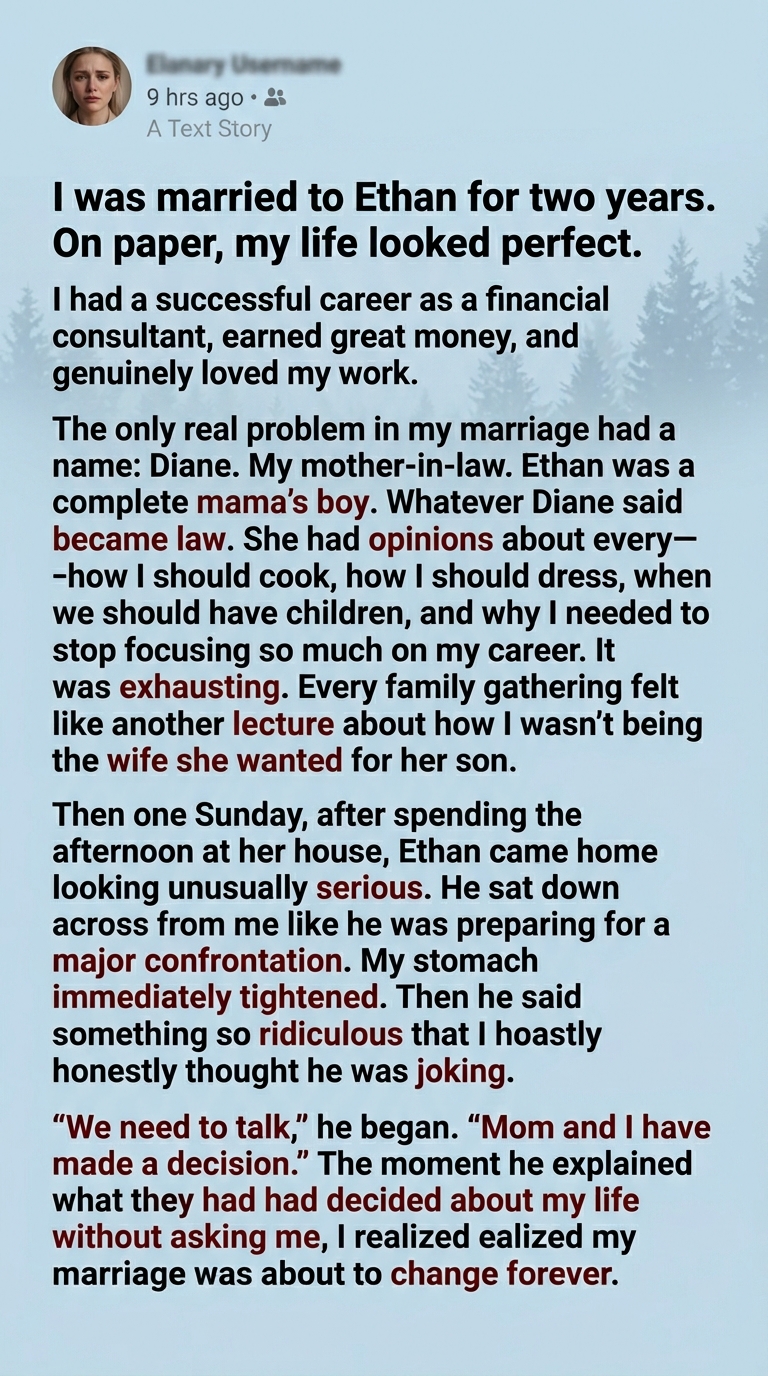
My husband sat me down and said, “Mom and I have made a decision.” What followed was so absurd I thought he was joking—until I realized they had already planned my future without asking me. That conversation changed my marriage forever.

I was married to Ethan for two years.

On paper, my life looked perfect.

I had a career I loved, financial independence, a beautiful home, and a husband who seemed kind and supportive.

Unfortunately, my marriage came with an extra person.

His mother.

And she had opinions about everything.

Her name was Diane.

Honestly?

If she’d simply disliked me, life would have been easier.

Instead, she treated me like a renovation project.

Every visit included suggestions.

Advice.

Criticism disguised as concern.

Apparently I cooked the wrong meals.

Worked too many hours.

Dressed too professionally.

Spent too much time focused on my career.

And not nearly enough time preparing to become the wife Diane believed Ethan deserved.

God.

It was exhausting.

The worst part wasn’t Diane.

It was Ethan.

Because Ethan never disagreed with her.

Not once.

If Diane said something ridiculous, he’d nod.

If Diane criticized me, he’d stay silent.

If Diane crossed a boundary, he’d find a way to explain it.

For two years, I kept hoping things would improve.

They didn’t.

Then one Sunday changed everything.

We had spent the afternoon at Diane’s house.

Nothing unusual.

Lunch.

Coffee.

The usual lecture disguised as conversation.

When we got home, Ethan looked strangely serious.

Not angry.

Determined.

Like someone preparing for an important meeting.

My stomach immediately tightened.

God.

Something felt wrong.

He sat across from me at the kitchen table.

Folded his hands.

Took a deep breath.

Then said:

“We need to talk.”

Honestly?

Those four words are never good.

Then came the sentence that almost made me laugh.

“Mom and I have made a decision.”

Mom and I.

Not we.

Not us.

Not my wife and I.

Mom and I.

I remember staring at him.

Waiting for the punchline.

It never came.

Then he explained.

According to Diane, I was becoming too focused on work.

Too ambitious.

Too independent.

Apparently my career was interfering with my responsibilities as a wife.

God.

Even writing those words still sounds ridiculous.

Then he said something I’ll never forget.

“Mom thinks it would be best if you quit your job.”

Silence.

Complete silence.

I honestly thought he was joking.

I actually laughed.

When he didn’t laugh back, I realized he was serious.

Very serious.

Apparently, they had discussed it extensively.

Together.

Without me.

They had decided I should resign from my position.

Stay home.

Focus on family.

Prepare for children.

Become more available to support Ethan’s goals.

My goals were apparently absent from the conversation.

Honestly?

I couldn’t believe what I was hearing.

I asked the obvious question.

“Why would I quit a career I love?”

His answer was somehow worse.

“Because Mom thinks you’ll be happier.”

God.

I looked around the room expecting hidden cameras.

It felt that absurd.

Then he slid a piece of paper across the table.

A written budget.

Created by Diane.

A detailed financial plan explaining how I could survive after giving up my income.

Every category was listed.

Food.

Utilities.

Clothing.

Entertainment.

Allowance.

Allowance.

The woman wanted to give a forty-year-old financial consultant an allowance.

Honestly?

That was the moment something inside me snapped.

Not angrily.

Clearly.

For the first time, I wasn’t looking at a difficult mother-in-law.

I was looking at a husband who genuinely believed his mother should have equal voting rights in our marriage.

Maybe greater voting rights.

And suddenly everything made sense.

The criticism.

The interference.

The constant opinions.

Diane wasn’t the problem.

Ethan was.

Because every boundary she crossed had been permitted by him.

Every inappropriate comment had been tolerated by him.

Every intrusion had been enabled by him.

God.

That realization was strangely liberating.

I pushed the budget back across the table.

Then asked a simple question.

“If your mother told you to divorce me tomorrow, what would happen?”

His silence answered everything.

Everything.

For nearly ten seconds, he didn’t speak.

Didn’t deny it.

Didn’t laugh.

Didn’t object.

Just sat there.

And honestly?

That silence told me more about my marriage than two years of arguments ever had.

The next morning, I scheduled a consultation with an attorney.

Not because of the budget.

Not because of the job.

Because I finally understood something important.

I wasn’t married to one person.

I was married to a committee.

And I only had one vote.

Over the following weeks, Ethan insisted I was overreacting.

Diane insisted I was selfish.

Both claimed they were trying to help me.

Funny how controlling people always describe control as help.

The divorce wasn’t dramatic.

No screaming.

No revenge.

No scandals.

Just clarity.

Pure clarity.

Several months later, the divorce was finalized.

And then something happened that still makes me smile.

A year afterward, I ran into Ethan by accident.

He looked tired.

Older.

Frustrated.

We talked politely for a few minutes.

Eventually I asked how things were going.

He sighed.

Then admitted he’d recently ended another serious relationship.

Apparently Diane didn’t approve of that woman either.

God.

I nearly laughed.

Not because I was happy.

Because some lessons repeat until people finally learn them.

As we said goodbye, he quietly asked:

“Do you ever regret leaving?”

Honestly?

The answer came easily.

“No.”

Not because divorce was easy.

Not because I hated him.

Because peace is worth protecting.

And nothing is peaceful about building a life with someone who allows another person to make your decisions.

Today, I still work in the career I love.

I built my business.

Bought my own home.

Created a life that belongs to me.

And every once in a while, I think about that moment at the kitchen table.

“Mom and I have made a decision.”

Those words were meant to control my future.

Instead, they gave me clarity.

Because sometimes the sentence that ends your marriage is also the sentence that gives you your freedom.

And looking back now, I wouldn’t change a thing.

My husband sat me down and said, “Mom and I have made a decision.” What followed was so absurd I thought he was joking—until I realized they had already planned my future without asking me. That conversation changed my marriage forever. Read More

The woman who abandoned me as a newborn showed up 25 years later demanding half of my business. I told her she could have it—under one condition. What happened next reminded me that being a parent isn’t about biology. It’s about showing up.

Doctors also told her she’d never have children.

Twenty-five years later, the woman who abandoned me as a baby showed up demanding half of my business.

What happened next is something I’ll never forget.

My mother wasn’t supposed to have the life she ended up living.

A car accident when she was young left her with devastating injuries.

For years, doctors doubted she’d ever walk independently again.

Some even told her she should stop hoping for children.

God.

Most people would have given up.

My mom didn’t.

She fought through endless therapy.

Pain.

Setbacks.

Disappointment.

And while she eventually learned to walk again, the doctors were right about one thing.

She couldn’t have biological children.

At least, that’s what everyone believed.

Then one rainy night, twenty-five years ago, she heard a baby crying outside her front door.

That baby was me.

According to police reports, I had been wrapped in an old blanket and left on her porch sometime before dawn.

No note.

No explanation.

No clues.

Just a crying newborn.

Honestly?

My mother never described that day as a tragedy.

She described it as the day her life changed.

The day she became a mother.

People told her she was crazy.

She lived alone.

She had mobility challenges.

Money was tight.

Everyone had opinions.

None of them mattered.

She adopted me.

Raised me.

Loved me.

And never once allowed me to feel unwanted.

God.

Looking back now, I realize how much she sacrificed.

School clothes she couldn’t afford.

Birthday parties she somehow managed to create.

Late nights helping with homework.

Early mornings driving me to activities.

Every success I ever had was built on sacrifices nobody else saw.

Years later, I started a clothing company.

A tiny business at first.

Then a larger one.

Then something much bigger than either of us imagined.

The day we opened our first headquarters, my mom cried.

Not because of the building.

Because she finally saw proof that every sacrifice had meant something.

Honestly?

That remains one of my proudest memories.

Then everything changed.

One ordinary Tuesday morning, our doorbell rang.

I answered.

A woman I’d never seen before stood outside.

She looked nervous.

Uncomfortable.

Almost emotional.

Then she introduced herself.

And my world stopped.

“I think I’m your biological mother.”

God.

My heart immediately started racing.

Thousands of questions flooded my mind.

Why now?

Where had she been?

What happened?

Why did she leave?

For a moment, I thought maybe there would be an explanation.

A heartbreaking story.

A tragedy.

A reason.

Something.

Instead, her eyes drifted past me into the house.

She looked around.

Not at me.

At the home.

The furniture.

The signs of success.

Then she smiled.

And said something I’ll never forget.

“Without me, you wouldn’t have any of this.”

Honestly?

I felt sick immediately.

Then she added:

“I think I’m entitled to half of your business.”

God.

Half.

Not a relationship.

Not forgiveness.

Not understanding.

Half.

The woman who left me on a doorstep was demanding ownership of the life someone else helped build.

Every sacrifice.

Every sleepless night.

Every risk.

Every success.

According to her, she deserved half simply because she gave birth to me.

I wanted to slam the door.

I wanted to tell her exactly what I thought.

Instead, I smiled.

Then I said:

“Of course.”

Her face immediately brightened.

Honestly?

That reaction told me everything.

Then I continued.

“But there’s one condition.”

The smile disappeared.

“What condition?”

I looked directly at her.

And said:

“If you want half of everything I’ve built, you need to reimburse my mother for half of everything she spent raising me.”

Silence.

Complete silence.

God.

The look on her face was priceless.

But I wasn’t finished.

I walked into my office and returned carrying several binders.

Over the years, my mother had saved everything.

Medical expenses.

School expenses.

Clothing.

Sports fees.

Tutoring.

College costs.

Food.

Housing.

Insurance.

Every receipt.

Every statement.

Every sacrifice.

Page after page.

Year after year.

I placed the binders on the table.

Then I handed her a calculator.

“Half comes to approximately $487,000.”

She stared at me.

Speechless.

I smiled again.

“Once you pay your half of the parenting costs, we’ll discuss my half of the business.”

God.

The room became very quiet.

Finally, she tried arguing.

Claiming motherhood wasn’t about money.

Claiming she had difficult circumstances.

Claiming life wasn’t fair.

Honestly?

For the first time, we agreed on something.

Life isn’t fair.

It certainly wasn’t fair to the disabled woman who raised a child everyone said she couldn’t raise.

It wasn’t fair to the baby left on a doorstep.

It wasn’t fair to the mother who spent twenty-five years doing all the hard work.

Yet somehow she survived all of it.

Without demanding anything from anyone.

Then my mom entered the room.

She had overheard enough to understand what was happening.

The biological woman immediately looked uncomfortable.

For several seconds, neither woman spoke.

Then my mother quietly asked:

“Are you the one who left him?”

The woman nodded.

My mother simply smiled.

Not angrily.

Not cruelly.

Just calmly.

Then she said something that still makes me emotional.

“Thank you.”

Everyone froze.

The woman looked confused.

I looked confused.

Then Mom continued.

“Because if you hadn’t left him, I never would have found my son.”

God.

There wasn’t a dry eye in the room.

Not even mine.

The biological woman left shortly afterward.

She never asked about the business again.

Never demanded money again.

Never contacted us again.

Honestly?

Part of me expected a dramatic legal battle.

Instead, she disappeared exactly the way she had twenty-five years earlier.

Only this time, it didn’t matter.

Because she taught me something important.

Giving birth makes someone a parent by biology.

Showing up every day makes someone a parent by love.

And those two things are not always the same.

Today, my company continues growing.

My mother still keeps every newspaper article.

Every award.

Every milestone.

Not because she’s proud of the business.

Because she’s proud of the person she helped build.

And if anyone ever asks who my real mother is, I don’t hesitate.

She’s the woman who couldn’t walk.

Couldn’t have children.

And somehow became the strongest mother I’ve ever known.

The woman who abandoned me as a newborn showed up 25 years later demanding half of my business. I told her she could have it—under one condition. What happened next reminded me that being a parent isn’t about biology. It’s about showing up. Read More

🚹They Called Him “A Charity Case,” Dumped His Award In The Trash, And Laughed
 Then The Cameras Turned Toward The Door

They Called Him “A Charity Case,” Dumped His Award In The Trash, And Laughed
 Then The Cameras Turned Toward The Door 🚹

“Before anyone touches that boy’s trophy again, I’d like the cameras rolling.”

That sentence cut through the auditorium like a church bell at a funeral.

Principal Whitmore froze with one hand still resting on the podium.

The board chairman’s son, Connor Vance, was standing beside her with my son’s trophy tucked under his arm like he had earned it.

And my son Theo was still standing near the trash can, one cheek red, both hands clenched at his sides.

Nobody moved.

Not the teachers.

Not the parents.

Not the students who had been whispering a minute earlier.

Because the man who had spoken wasn’t a parent they recognized.

At least, not in the way they should have.

He was my father, Dr. Malcolm Hale.

A retired research titan.

Founder of Hale Applied Systems.

The man whose company had quietly funded patents, laboratories, medical robotics, and half the technology partnerships that schools liked to brag about in glossy brochures.

But to Principal Whitmore, he was just an older man in a dark suit interrupting her perfect ceremony.

She forced a smile.

“Sir,” she said, her voice sharp, “this is a private school event. You can’t simply walk in and disrupt—”

My father lifted one hand.

He didn’t shout.

He didn’t need to.

“Madam Principal,” he said, “I was invited.”

Then he turned slightly.

The county education commissioner stepped forward.

So did two reporters with camera crews.

The room began to buzz.

Principal Whitmore’s face went pale.

Board Chairman Richard Vance cleared his throat.

“Dr. Hale,” he said quickly, “perhaps we can discuss this privately.”

That was the first time anyone in that room heard the name.

Dr. Hale.

A few parents turned to each other.

One teacher covered her mouth.

Because the brand-new Hale Technology Building sat right across the courtyard.

The same building Principal Whitmore had spent six months posing in front of.

The same building featured on every banner that night.

The same building she kept calling “a symbol of our school’s commitment to merit, innovation, and character.”

My son Theo still hadn’t said a word.

He just looked at me.

I gave him the smallest nod I could.

Stay calm.

We had learned that the hard way.

Two months before the gala, Theo came home quieter than usual.

He didn’t slam doors.

He didn’t complain.

He just set his backpack down and said, “Dad, is it wrong if someone wins because adults want them to?”

I asked him what happened.

He shrugged.

That was Theo’s way of hiding pain.

He told me Connor Vance had been bragging that the grand prize was “already handled.”

He said Principal Whitmore had visited the science lab twice and told the independent judges that Connor represented “the leadership future of the school.”

Theo said one teacher whispered, “Just keep your head down.”

So I did what angry fathers rarely want to do.

I did nothing obvious.

I told Theo, “Build the best project you can. Let them reveal themselves.”

He did.

His project was a compact flood-rescue drone system.

It could identify heat signatures, drop emergency flotation packs, and send GPS signals to first responders.

He built it after watching news footage of families stranded during storms.

Connor’s project was a polished slideshow about “future innovation.”

His father’s assistant had clearly made most of it.

The judges weren’t fooled.

Three independent engineers scored Theo first.

Not close.

Not questionable.

First.

And under the official competition rules, their scores were final.

That should have been the end.

But entitlement never stops at losing.

It tries to rewrite the scoreboard.

On the night of the centennial ceremony, the auditorium looked like a wedding reception for rich people who wanted applause.

Crystal lights.

White flowers.

A brass quartet.

Banners reading: 100 Years of Excellence.

Theo stood backstage holding his trophy card.

He was nervous, but proud.

He had earned that moment.

Then Principal Whitmore walked over with Connor and his father.

She looked at Theo’s worn shoes.

Then at his blazer.

Then at me.

She didn’t know me.

That was intentional.

“You must understand,” she said quietly, “this school has traditions.”

I asked, “What tradition is that?”

She smiled without warmth.

“Children from certain homes are prepared to carry a name like ours.”

Theo heard it.

Connor heard it too.

He smirked.

Then he leaned toward my son and said, “You should’ve just been happy they let you compete.”

That was the moment my hands curled into fists.

But my father’s voice was in my head.

Let the record speak.

So I took out my phone and pressed record.

So did three other parents nearby.

Principal Whitmore went onstage and announced the award.

For one beautiful second, she said Theo’s name.

The audience clapped.

My boy walked into the lights.

He looked so small up there.

Small, but steady.

He held the silver trophy.

Then Whitmore’s expression changed.

She leaned into the microphone and said:

“After administrative review, we believe the spirit of this award belongs to Connor Vance.”

The applause cracked apart.

Some people stopped clapping.

Theo looked confused.

“The judges selected Theo,” one science teacher said from the front row.

Whitmore ignored her.

She took the trophy from my son.

Theo whispered, “But I won.”

The microphone caught it.

Everyone heard.

And that should have made her stop.

Instead, it made her angry.

She turned to the audience and said, “Some children must learn humility before achievement.”

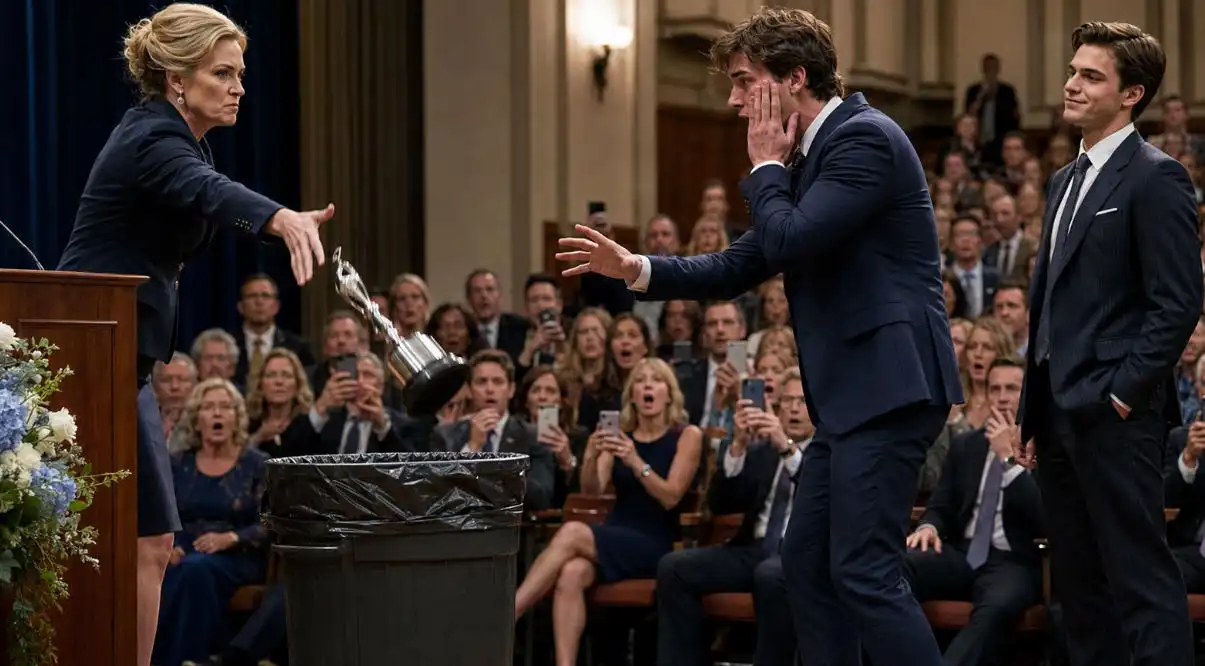
Then she walked to the edge of the stage and dropped the trophy into the trash can.

The sound was ugly.

Metal against plastic.

A cheap, hollow thud.

My son reached for it.

She slapped him.

Not hard enough to break skin.

Hard enough to break the room.

Gasps flew through the auditorium.

Someone said, “Oh my God.”

Someone else said, “Did she just hit him?”

Whitmore hissed, “Don’t embarrass this institution.”

That was the line.

Not “Are you okay?”

Not “I’m sorry.”

The institution.

That was what mattered to her.

Not the child.

Not the truth.

Not the award.

Her image.

Her donors.

Her board.

Her precious ladder of power.

So I didn’t rush the stage.

I didn’t give her the scene she wanted.

I texted one word to my father.

Now.

Because the legal hammer had already been built.

Six months earlier, when my father donated the money for the technology building, he did it anonymously through the Hale Foundation.

But he had conditions.

Not suggestions.

Contractual conditions.

The school accepted the money under a donor covenant requiring transparent academic awards, independent judging, no retaliation against students, and mandatory reporting of administrator misconduct.

Any violation allowed the foundation to suspend future funding, demand an external audit, and require board-level disciplinary review.

There was more.

The science competition had been registered with a county STEM partnership program.

That meant the submitted scores, judging sheets, and award records were not casual school decorations.

They were official program documents.

Changing the winner after certified judging?

That was not “school discretion.”

That was falsification.

Publicly striking a student?

That triggered mandatory reporting.

Humiliating him for donor politics?

That triggered the ethics clause.

Principal Whitmore thought she was protecting powerful people.

She had no idea she was stepping on a trap made entirely out of her own arrogance.

My father walked down the center aisle.

The cameras followed.

The commissioner stood beside him.

“Principal Whitmore,” the commissioner said, “before this ceremony continues, I need to ask whether the award decision was changed after the judges submitted final scores.”

Whitmore swallowed.

“I made an administrative adjustment.”

The commissioner looked at the science teacher.

“Were the judges’ scores final?”

The teacher stood up, shaking.

“Yes.”

Whitmore snapped, “Sit down, Marianne.”

The teacher did not sit.

“No,” she said, her voice breaking. “I won’t. Theo won by nineteen points.”

The room erupted.

Parents started talking over one another.

Connor’s father stepped forward.

“This is absurd,” he said. “My son is being embarrassed.”

My father looked at him.

“Your son is holding another child’s trophy.”

Connor’s face went red.

The commissioner turned to Principal Whitmore.

“Did you instruct staff to alter the public announcement?”

Whitmore said nothing.

Then one of the reporters raised a printed document.

“We received copies of the judging sheets before we arrived.”

Principal Whitmore stared at the paper like it was a snake.

My father hadn’t come with anger.

He came with receipts.

Emails.

Score sheets.

Security footage from the lab hallway.

The donor agreement.

A text from Whitmore to Chairman Vance that said:

“Don’t worry. Connor will not be humiliated at the centennial. I’ll handle the optics.”

That text hit the room like thunder.

Chairman Vance turned gray.

His wife stood from the front row and whispered, “Richard?”

He didn’t answer.

The commissioner asked Principal Whitmore one final question.

“Did you strike this child?”

Whitmore tried to recover.

“He reached aggressively toward me.”

A parent shouted, “No, he didn’t!”

Another held up her phone.

“I have the whole thing recorded!”

Then twenty phones rose in the air.

Twenty witnesses.

Twenty angles.

Twenty versions of the truth she could not buy, bury, or rename.

My father walked to the trash can.

He looked at Theo.

“May I?”

Theo nodded.

My father reached in and pulled out the trophy.

A banana peel had smeared the base.

A napkin stuck to one corner.

The symbol of my son’s hard work looked like it had been dragged through shame.

My father took out his handkerchief and wiped it carefully.

Slowly.

Respectfully.

The auditorium was silent.

Then he turned to Principal Whitmore and said:

“You threw away the wrong trophy.”

He placed it back into Theo’s hands.

That was when the room finally broke.

People stood.

One clap.

Then another.

Then the whole auditorium rose to its feet.

Theo stared at the trophy.

His lip trembled.

But he didn’t cry.

Not yet.

Principal Whitmore tried to leave the stage.

The commissioner stopped her.

“The board will convene immediately,” he said. “And until the investigation is complete, you are removed from student contact.”

Removed.

In front of everyone.

No private hallway.

No soft landing.

No graceful exit.

The same public stage she used to shame a child became the place where her authority ended.

Chairman Vance resigned from the school board before midnight.

By the next morning, local news had the story.

Not because we begged for attention.

Because people had watched a child get humiliated and decided silence would make them part of it.

The investigation widened.

It turned out Whitmore’s sister worked in a district scholarship office.

Her cousin sat on a private-school accreditation review panel.

Her brother-in-law had been consulting for schools seeking STEM grants.

None of that was illegal by itself.

But emails showed favors.

Pressure.

Recommendations traded like currency.

“Help this family.”

“Move this application.”

“Delay that complaint.”

Once the first wall cracked, the whole hallway collapsed.

Within three weeks, Principal Evelyn Whitmore was fired for misconduct, falsifying award records, and violating student safety policy.

Her sister resigned after an ethics inquiry.

Her cousin was removed from the accreditation panel.

Her brother-in-law lost two consulting contracts when schools realized his access came with strings attached.

As for Connor, he transferred quietly.

I don’t celebrate that part.

He was a kid too.

But he had learned cruelty from adults who mistook privilege for character.

I hope losing taught him more than winning that stolen trophy ever would have.

And Theo?

That was the part that healed me.

A national STEM foundation heard about his flood-rescue drone.

They invited him to present at a youth innovation summit.

Two universities with early STEM programs offered mentorship.

One private academy offered him a full scholarship through graduation.

Not because he was my father’s grandson.

Because his work was real.

Because the judges were right.

Because a child who gets knocked down in public and still refuses to lie deserves a room full of people willing to stand up.

The old school tried to recover its image.

They issued a statement.

They promised reforms.

They renamed the award process.

They also asked the Hale Foundation not to withdraw support for the technology building.

My father agreed to keep the building open.

But only under new oversight.

“Children shouldn’t lose a lab because adults lost their integrity,” he said.

That is the kind of justice I believe in.

Not revenge for revenge’s sake.

Correction.

Accountability.

A locked door opened for the students who still needed it.

Months later, Theo and I drove past the old school.

It was early morning.

The sidewalks were wet.

A woman in a maintenance vest was sweeping leaves near the front gate.

Theo looked out the window and went quiet.

It was Principal Whitmore.

No podium.

No pearls.

No microphone.

Just a broom, a gray sky, and the same sidewalk where she used to greet donors like royalty.

Theo didn’t smile.

He didn’t mock her.

He just watched for a second and said:

“I hope she doesn’t treat the janitors badly.”

That was my son.

After everything, he still worried about the next person below her.

That’s when I finally cried.

Not because she fell.

Because he didn’t become cruel.

A few weeks later, Theo’s new school held a small assembly.

Nothing fancy.

No chandeliers.

No board members posing for cameras.

Just students, parents, teachers, and a folding table with lemonade.

They asked Theo to talk about his project.

He walked to the front holding the cleaned trophy.

The same one from the trash.

A tiny scratch still ran across the base.

He could have hidden it.

He didn’t.

He tapped it gently and said:

“This mark reminds me that people can throw away what you earned, but they don’t get to decide what it’s worth.”

The room stood for him.

This time, nobody took the trophy away.

This time, nobody told him to know his place.

This time, he knew it.

Right in the light.

With his head up.

And for every parent reading this, here’s the line I’ll stand on:

A child’s dignity is not negotiable.

Not for donors.

Not for board members.

Not for traditions.

Not for “the right families.”

So pick a side and say it plainly:

Was Principal Whitmore’s downfall deserved
 or should adults get second chances after publicly humiliating a child? Share this if you believe kids should never have to be powerful to be protected. 🏆

🚹They Called Him “A Charity Case,” Dumped His Award In The Trash, And Laughed
 Then The Cameras Turned Toward The Door Read More